
Overcoming obstacles and finding new paths – examples on how study dreams can become true

Pablo Santur compiles five stories with unreal challenges students faced to study in Oulu.

We are living an extraordinary time, facing a worldwide challenge that demands us to follow the rules, stay at home, and not gather with friends. It is difficult to remain focused when the landscape is uncertain, giving us no clue of what is coming next. But previously I have faced many similar times, and I guess you have, too. 

For me, the most challenging decision I had to make was to leave South America and come to Oulu, a place that I had no ties with. No friends, relatives or even acquaintances. Zero.

I came here following the dream of studying in one of the best educational systems, and the principle of Finnish society granting equal education opportunities for everyone. From where I come from, that is not taken for granted. Despite many beautiful things Peru offers, good public education and equal opportunities are not among them. It is a hierarchical society, where private education is valued and expensive. Knowing that, my parents paid for my education. They also had a dream of all their children becoming professionals.

It was not easy to come to Oulu. First, I had to embrace the idea of leaving my parents, friends, and the life I had built at that point, and also to save the money needed to live here for a couple of years. A climate crisis in Peru in early 2017 and an accident made the journey more exciting but not less challenging. 

When talking about my experiences with my classmates and other students I found similar stories. In some cases, they faced obstacles way tougher. 

When an interviewee requested to remain anonymous, I created a pseudonym for them. So, you can identify them with this symbol (*).

Life is about creating yourself

Everything we have achieved was by trial and error: walking, completing a video game, or riding a bicycle. If we have mastered something, either injuries, embarrassments, or discouragements were involved in it; and perseverance was a keyword when sticking to our goals and when we kept pursuing them. Perseverance was also a keyword for our interviewees.

Miikka Enbuske dreamed of joining the International Business Management program since 2008. After his first application received a negative response, he gained admission to a university of applied sciences. However, every year he kept applying to the same program. Although the answer remained the same, “we regret to inform you…”, Miikka still had the feeling that he could perform well. He only needed to get in. However, many years had to pass by before he was able to do it.

“Getting accepted to the program was the easiest step, challenges started after that. The main ones were paying the tuition fees and the residency permit.”

On the other side, Abdul Kur(*), a master student of Learning, Education and Technology (LET), had a totally different experience.

“Getting accepted to the program was the easiest step, challenges started after that. The main ones were paying the tuition fees and the residency permit.” 

The economy of his home country was collapsing, and the currency was losing value rapidly. However, he remained committed to the idea of starting his studies on time. 

“I was sure that if I didn’t manage to start my higher education abroad then, it would be impossible in the near future, so I tried my best to overcome the challenges.”

To face such a daunting situation is not easy. After getting rejected the easiest step would be to quit. Just forget the thing and jump to something else. But, on the other side, those challenges could also be understood as a way to demonstrate our commitment to the goal.

Miikka had one child, a second one coming, and a job, but he was still convinced that university would change his life, and he persisted. 

Likewise, Abdul got two jobs and started his own small handicraft venture, all to get the money he needed.

”I and a friend were making fancy paper bags. We bought the paper waste from a paper-box factory, used it to produce the bags, and then sell them to gift shops.”

Don’t count your chickens before they hatch

Rohit Mishra and Taslima Uddin(*) were also thinking about Oulu to follow their studies in Education and Architecture, respectively. With a background in engineering and many years as an educator, Rohit found the LET program was the best fit for him for including both self-regulation theories and technology-enhanced learning. By her side, Talisma was looking to dive deeper into architecture as well as a closer contact to nature. 

“Since I began my professional studies, different styles of architecture were an inspiration to travel. Finland was a great choice as the architecture here is quite contrasting to what I am used to practicing in Southeast Asia.”

“I felt trapped in a phase and I couldn’t get myself out.”

Considering their dreams, they both became extremely happy after receiving their acceptance letters. So, they started to plan their lives in Oulu, without expecting the bad news about to come. 

As Rohit explains: “After getting admission, I started the process of the residence permit (RP) quite late, thinking it won’t take much time. I quit my job and accepted the offered housing, bought flight tickets, and started other processes before thinking about RP. A terrible mistake.”

For Taslima, the shock of such a defining moment also had emotional and practical consequences. As she explains: “I quit my job because I knew I was about to leave, so being unemployed turned out to add more stress to the situation. I had all the time in the world at hand but nothing to do or plan, as I could have received the decision any day and fly out the next morning. I felt trapped in a phase and I couldn’t get myself out.”

So, both Rohit and Taslima had to deal with something beyond their control. Setting up their plans for years, just to fall so close from the top of the mountain they were about to conquer. A little bit further in the journey, Masud Mohamed(*) faced a similar situation that he was not able to foresee. He was in Egypt, in his hometown, in 2013, when the military coup took place. Witnessing the injustice and the feeling of helplessness pushed him to look for new horizons abroad. 

Three years later, already as a master student in environmental engineering, he thought the crisis was gone, but one night it suddenly struck back. 

“It happened three months after I came to Finland. I had all my savings in Egyptian pounds (EGP) because it was nearly impossible to make the change to Euros. So, one night I went to sleep, with the equivalent of € 10,000 in EGP in my bank account, but the next morning the currency value was slashed in half, and so were my savings.”

Recalling this event, the sadness and anger Masud felt at that moment becomes evident. A lot of effort invested, lost in the blink of an eye. It is just heartbreaking. Despite how arduous that moment was, Masud found the strength to keep going from his family.

“My mom recommended me to focus on what I came here for, and not to worry about the money. She told me I will get the financial support I need to pursue my dream, even if that meant selling everything they own.” 

Similarly, Taslima, Miikka, Rohit, and Abdul also found in their families an invaluable support to keep pursuing their dreams. 

What doesn’t kill you makes you stronger

“Nobody can hurt me without my permission.” 

In such a short phrase, Mahatma Gandhi was able to summarise that whatever situation you are facing, it is your reaction to it what shapes it.

In the end, are not the circumstances, but our response to them what defines us? In the case of our interviewees, the challenges faced led them to unexpected situations.

Even though the negative response, Rohit decided to create alternative paths before applying again to the master’s program. 

“Despite the odds, I took it as an opportunity to put the theory of Self-Regulated learning in practice. I set a goal of completing my proposed research idea by collecting data through a pilot project. I intended to present it in an international conference during the early stage of my master’s program to collect feedback and to refine it.” 

However, his strong will was about to be tested again. 

“The year 2018 was not an easy one; my friends and family were sceptical and concerned seeing the effort I was putting in for attaining the goal in absence of any assurance of result. However, for me, there was an assurance: an assurance of learning.” 

Luckily, one year later, his efforts paid off when he was able to present his research in an international research conference.

But Rohit was not the only one who throve under hard circumstances. Similarly, Masud also found a reason to persist in difficult times.

“The challenge gave me the motivation to work harder so I would not disappoint anyone who supported me, and so all the troubles I went through wouldn’t be in vain. I was given an opportunity that millions around the world only dream of; I did not want it to waste it. I was determined to succeed.” 

The life-changing experience led Masud to devote himself to studies and his dedication was rewarded when he got two internships and the funding from the City of Oulu Internationalization Scholarship in 2017. 

As he explains with a big smile: “The experience brought out the best in me. I was able to achieve things I did not think I was capable of.” 

Taslima had to defer the beginning of her studies by one year. However, the waiting process helped her to realize that spending time with her parents is what she valued the most, especially now she is in Oulu. 

“I am really happy that I finally made it to Oulu. Compared to the first time, I value the opportunity more now. It also made me aware that situations may change and not take the expected course. But at the end of the day it also passes away, so I accept feeling sad or scared too. Every experience leaves a mark on us, and this experience made me mentally stronger.” Luckily, the conquered challenge brought wisdom and joy to her.

For Miikka, thinking about this experience made him thankful for the support he received from his family and friends. Especially from his wife, who always pushed him forward. 

Reflecting about his previous effort also helped him ponder about his future. 

“I think everything has a purpose and I have gained valuable working experience before my studies, and I can reflect on that. I also know what I do not want to do in the future professionally. My challenges also taught me how to overcome my past weaknesses and that I can demand a lot more from myself than what I had demanded before.”

***

It may be that we are at the beginning, the middle, or the end of the journey. Wherever we are, new challenges will always show up. For me, arriving in Oulu came also with new challenges to overcome, such as improving my communication and intercultural skills, learning how to deal with the local weather, and more currently: writing a thesis and dealing with the COVID-19 virus pandemic.

However, if you are facing an extremely discouraging moment, I hope you got as inspired as me when finding the wisdom in the stories above. So, rely on your beloved ones and find the strength to keep going forward. As Odin said in ancient Nordic mythology: “Strength and virtue must be challenged, or they will not grow.” 

After this time is gone, we will all be stronger.

Pablo Santur

Learning specialist in thesis writing mode. Former TV scriptwriter. Foodie. Anime lover. Twitter: @pablodsantur

Lue lisää:

Early mornings and above average organisational skills – that is what it takes to combine university studies with a family life

Studying and raising a family at the same time can be challenging. We interviewed four students to better understand their experiences.

We know it, student life is tough. We might have an idea that family life is not extremely easy, either. What about combining the two? 

Well, the result is a mix of many things: trips to the daycare and to university, studying during breaks or while on the bus, and bracing yourself for “surviving the evenings”.

Ella, 25, from Oulu follows a five-year program in primary school teacher education. She hopes to graduate before Christmas this year. Besides her major, she is studying two long minor qualifications in biology and geography (60 ECTS each). Ella is the mother of an almost 6-year-old child.

David, from Ireland, started his studies at the University of Oulu in 2013. He graduated from the master’s program in Education and Globalisation (EdGlo) and started the Intercultural Teacher Education (ITE) program a short time later. He is also the father of a 5-year-old child. 

Ela B., 31, from Albania was studying her PhD in Business School when she became pregnant with her first child. Because her business studies involved lots of traveling, Ela B. decided to quit her PhD and apply for the ITE program, which she started in January 2017. Now, her first child is almost 4 years old and she has an 8-month-old baby. 

Michelle, 34, is from Aanaar (Inari), Finland. She is a mother of “two and a half children”. The oldest one is five-and-a-half, the second one four, and the third one is due in June. Michelle obtained a bachelor’s degree in Teacher Education, a master’s degree in Philosophy of Indigenous People, and is currently writing her PhD in Saami Culture and Education.

A day in the life of a parent

The day starts early for Ella. She wakes up at 7 am in order to take her daughter to the daycare by 8 am, so she can get to her courses starting at 8:15. Similarly, David and Michelle wake up early, put their children on the bike, ride to the daycare centres, and from there to the University.

Ela B. remembers her first spring of studies as getting up at 6:30 am – very quietly so she wouldn’t wake up her baby – placing the porridge, vitamin D drops, water cup and the bib on the kitchen table, checking the diaper bag, and putting everything on the stroller. 

“I was continuously worried and wondered if it is selfish of me to return to my studies so soon.”

After breastfeeding, Ela B. had to head for the University while her baby remained in the care of her partner.

“I was continuously worried and wondered if it is selfish of me to return to my studies so soon,” she says.

No earlier than at 3 pm in the afternoon, both Michelle and Ella return to daycare to pick-up their children.

“Me and my husband try to alternate between who has a shorter day and is picking up the kids. I am the one who more often picks them up,” says Michelle.

On the other hand, David and Ela B. occasionally have classes or exams scheduled until 6 pm. David finds this incredibly frustrating, as it means problems in arranging care for his kid and spending less time with his little one.

“I have to survive the evenings,” Michelle jokes. Similarly, Ella describes all the chores she has to do in the evening: prepare food, clean, take her child to different hobbies and clubs and find time to visit the gym herself.

“I might sometimes envy the students without children who, after a school day, get to go home and do whatever they want, while my time is spent running from one chore to the next. However, I wouldn’t change places for anything!” Ella admits.

Productivity taken to the next level

All four parents say that combining higher education studies with raising a child takes above average organisational skills.

“I try to write all my essays and reports while I am at the University. Fortunately, I only have a few courses at the moment, so it is possible. There is no way I could see myself managing if I had the same workload as the last couple of years. I take full advantage of the days when my kid is not with me to work, so we can spend as much time as possible when we are together,” David says.

“I think that the most difficult part of combining student life with family life is time management. I carefully plan what I am going to do and when everything has to be done.”

In Ella’s case, if there is still homework to do, she usually does it after her child goes to sleep. The other option is studying in a different room while her husband is playing with the little one. Both options are rather bad, since if she is doing her coursework in a different room, she gets interrupted often, and in the evenings she is already tired herself.

“I think that the most difficult part of combining student life with family life is time management. I carefully plan what I am going to do and when everything has to be done,” she says.

Michelle explains that she, as well, tries to work after nine in the evenings, when her kids are asleep. Sometimes, however, the evenings become chaotic and there is less and less time for working.

Ela B. remembers answering urgent emails or WhatsApp messages and updating her calendar while on the bus home during her first semester as an ITE student. 

Sick days add extra work

Michelle points out that it is particularly difficult to combine studies with parenting when the children fall sick. Her point of view is extremely popular amongst the other interviewees. 

“You are punished for your kid being sick. You get in trouble for missing the lectures. You are required to do extra assignments, which often mean double the workload than attending the actual lecture,” David says.

He adds that a student shouldn’t be expected to choose between family and school, “because there is only one winner”. 

Likewise, Ella explains that the attendance demands of the Faculty of Education (an 80 % or 90 % attendance on the courses is compulsory) can sometimes cause trouble. If her child is sick and she has to stay at home, Ella needs to do extra tasks to compensate for the missed lessons.

“A sick child is already consuming a lot of energy from the whole family. Adding extra tasks on top of that feels unfair.” 

Ella considers that the attendance policy should be changed. If one must be absent due to the child’s illnesses, the compensatory tasks should be skipped. She also considers the attendance policy useless at university level, because each student is responsible for their own learning process. As a result, there is no need to impose attendance requirements.

Financial difficulties hit families 

Compared with working parents, financial strain is one disadvantage studying parents face. From Ela B’s perspective, this is the biggest challenge, because the study benefits are lower than a salary.

“I have been dreaming of living close to a forest in either a row house or a detached house with a yard where the children could just go out, play, and wander safely in nature,” she says. 

David points out that from a financial perspective it is disadvantageous to stay in the University for a long time. That is why there should be more support and flexibility in completing the studies. During summer, students are expected to either work or study. Due to having shared custody, and his kid’s daycare being shut in July, David has few options for summer work. This leaves him with only the study option.

However, due to lack of summer courses conducted in English, David has to take random courses during summer, because there are no courses that would help him make progress in his studies. Still, he needs to study something to receive the student benefits.

Lack of safe space to play

Lack of child-friendly facilities and childcare personnel at the University is another challenge for the students with children. Lastu, the University’s daycare centre located on the Linnanmaa campus, is not really an option, since they offer only part-time childcare. Our interviewees think it would be better if they extended it to full time.

For David, a similar challenge arises because of the distance he has to bike every day. His home, the daycare, and the campus are located far away from each other.

Ela B. found it very easy to bring her children to lectures, groupwork meetings, or social gatherings. The reason being that all her study friends love children and know how to be around them. 

Despite having the same positive experience with teachers and peers, Michelle and David consider bringing their children to lectures not so easy in practice.

“At times, my own strength is being tested. My days are so full and my free time so limited.”

According to them, older children need more attention, disturb the class, or find it boring.

“Five-year-olds don’t sit on a chair for one hour and half,” says David. He and Ela B. think that the University is not a welcoming environment for kids. They say that a small place for children to play indoors, like the ones they have in the shopping centres, would be a good addition to the campus.

The burden of both family life and student life sometimes takes a toll on the mental health of parenting students.

“At times, my own strength is being tested. My days are so full and my free time so limited,” Ella admits.

For PhD students like Michelle, competition is very intense, and funding is secured by good and constant progress. That makes her wonder sometimes if she is doing “a good enough job”. 

Meanwhile, Ela B. feels that it is very difficult to leave her children and go to school when they beg her not to go.

David is annoyed by the University’s outdated perception of a student as being “straight out of high school, with a lot of parental and social support”. 

He underlines the fact that “one rule fits all” is not an inclusive way of designing studying guidelines and policies.

More flexibility needed

Michelle thinks that it would be nice to make it more visible and clearer that the University facilitates balance between working and family life. Ela B. would like to take part in more events organised for students with families. She already took part in the barbecuing event and enjoyed it. Although she couldn’t go to the family concert organized this spring in the University, she found it as a great idea.

From David’s perspective, some teachers don’t understand that there is a life outside school, and that students’ lives in general have changed. He adds that there should be more flexibility in completing studies and clearer guidelines.

Of course, there are positive aspects of combining studies with family life as well.

Michelle enjoys the flexibility offered by her PhD: “I can adapt my working time according to family life.”

“I owe it to my child that I am now doing something I am really passionate about and happy with,” Ela B. explains, because she made the decision of changing her career when she first became pregnant.

Moreover, Ela B. was reading every single book page and article on child development for her degree with immense interest, because she could see all those things on an everyday basis.

“Combining parenthood and teacher studies made me both a better parent and a better teacher.”

Right to rest?

Luckily, the University already had plans on creating childcare rooms on the Linnanmaa campus, which were supposed to be opened at the end of March. Due to the COVID-19 situation and the closing of the university’s premises, the childcare room is not yet in use. Unfortunately, there are no similar plans for the Kontinkangas campus, due to multiple challenges, like the lack of space.

The Student Union of University of Oulu’s (OYY) policy paper mentions flexible studies and a sufficient number of summer courses organised both in Finnish and English, so these are among the aims of OYY’s advocacy work.

On the other hand, all students in Finland are facing problems related to student benefits and holidays. According to Sanna Kangasniemi, the Student Union’s Social Affairs Specialist, last summer (2019) the National Union of University Students in Finland (SYL) made a statement with the headline “Why don’t students have a right to breaks and holifdays?” regarding the fact that students are the only group in Finland with no right to holidays and the related financial support.

“The students are subjected to strict criteria with regard to social assistance. To receive it, they must prove that no suitable summertime courses are available, that they have applied for work, and that all of the student loan to which they are entitled to have been used. In other words, students are required to use loans intended for subsistence while studying, in order to support themselves outside their periods of study”, Kangasniemi says.

In conclusion, the lives of students who are also parents pose both specific challenges and more general ones related to student life. And the solutions are not easy for either. 

But as Ella admitted “The best thing is that, when I return home, I find there the most beloved and important people in my life. That gives me power”.

Anca M. Catana

Education student, theater enthusiast, nature lover. Curious, spontaneous and ambitious, open for new challenges.

Lue lisää:

Time to say goodbye – how it feels to leave Oulu

In this article Pablo Santur interviews former students, tells their stories and explores how it feels to be leaving Oulu and say goodbye.

Many of us came to Oulu excited for the new path unfolding in front of us. Since the moment we decided to come, we knew a journey was beginning. Only at the very end can we say if we got what we were looking for.

We may have begun seeking a better future, a professional improvement, or just a new beginning. Still, we can never be fully aware of the potential hiding behind our expectations. The unexpected parts are the places to discover, moments to live, or challenges to overcome. 

Once someone told me that the difficult part of going back home after staying somewhere for a long time is realizing that you have two homes. You are going back to your family and friends, but also leaving behind new friends. In this article we are going to discover pieces of the journey of some former students who already left Oulu, and hear how it feels to say goodbye.

Every journey begins with a step

To reach the university, we all had to take many different steps. Some reached the university in a rush, without too much planning. This was the case of Héctor Pijeira-Díaz, Vasiliki (Vaso) Mylonopoulou and Tiina Strand

Héctor was still working on his master’s thesis in Spain when he found out about a PhD position in Oulu and decided to apply. Similarly, Vaso was in Sweden looking for a job when she was accepted as a doctoral student. That was the beginning of the journey for them. 

It was a little bit different for Tiina. She was originally planning to go further down south from Sodankylä, her hometown. However, her plans changed when she was accepted to the university of Oulu. Even then, she thought it was only going to be for 5 years. In the end, it turned out it would take longer than that before she continued the journey she had in mind years earlier.


Feeling lonely and friendless was the hardest thing I faced in Oulu.


Not everyone’s path was full of unexpected turnarounds. There are those who were able to picture the path they were going to follow and execute the plan with surgical precision. That was the case for Axel Cima, Lourdes Malacara and Kassandra Hernández. From all corners of Hispanic countries (Argentina, Mexico and Spain, respectively), they did an extensive search for programs that matched their interests.

While Axel was focused on economic geology, Lourdes and Kassandra were interested in education. Lourdes was interested in the links between education and technology, while Kassandra wanted to look into the pedagogic strategies of Finnish teachers. After a lengthy process reviewing several programs in different cities, they choose Oulu as their destination.

Fatema struggled to make friends at first.

Looking for company for the ride

As main characters of our own story, we accepted the solitude in coming to Oulu and leaving behind our familiar lives. Even though every journey began individually, we needed to build bonds with people to overcome the challenges along the path. For some it was easier, while others struggled.


The sense of community is very precious thing and it’s hard to come by after you graduate.


The latter was the case for Fatema Tuj Zohora, then Master student in molecular medicine. Even though she found many opportunities for her research interests at the university, she had a hard time developing connections. As she remembers: “In the very beginning, I didn’t feel welcomed. It was very hard to find a friend in the classroom. Feeling lonely and friendless was the hardest thing I faced in Oulu.” 

Some other students were lucky enough to be able to find a group of people that accompanied them through the entire journey. Axel is grateful for the solid group of classmates who stuck with him during his 2-year programme. 

“Since the very beginning we formed a wonderful group of international people from every continent and we stuck together. Multiculturalism and friendship were great pillars for this experience.”

Likewise, Tiina highlights the relevance of people in her university experience. Vappu has especially been a very special time for her. 

“It felt like all the students were out and about and you could make new friends everywhere. The sense of community is very precious thing and it’s hard to come by after you graduate.”

Hector’s biggest challenge was his multidisciplinary PhD.

Surprises along the path

A Finnish expression says: “Elämä ei ole ruusuilla tanssimista” – literally, life is not dancing on roses – meaning life is not exempt of troubles. Indeed, the troubles faced along the way also left deep traces in us. 

One challenge for exchange students was the cold and long-lasting dark season. Lourdes knew about the cold weather before arriving, but she still felt sad and lacked energy to do her research during the winter. 

“I wanted to sleep most of the time and did not want to do my assignments”, she says. 

Despite the struggle, winter changed Lourdes’ view about locals for the better. 

“Before moving to Finland, I had the notion that Finnish people were ‘cold’. Instead I found that while Finnish people take their time to know you, once they trust you they are really friendly and nice. They really care for their friends, and they support you in difficult times but also in happy moments”, she says.

Sometimes the biggest challenge was else, something you could not see coming. That was the case for Vaso, for whom her studies became the biggest challenge to overcome. 

“I think the PhD itself was difficult. I have not yet met a doctoral researcher who is doing perfectly well mentally. A PhD takes years, and one really only believes that they can make it at the defence. The years before are full of uncertainty, doubts, and random deadlines.”

Similarly, his PhD challenged Héctor to reinvent himself. Coming from a totally different academic background, he had to work extra hard to fully embrace the multidisciplinary nature of his research.


I have not yet met a doctoral researcher who is doing perfectly well mentally.


“I had an engineering background and came to work in educational psychology. My thesis had a very strong component of physiological data. So, you know psychophysiology, educational psychology, computer science, that mix was difficult.” 

Kassandra feels sad to be leaving Oulu.

The end of one journey is the beginning of another

At the end of the journey, new decisions had to be made for the future. In the case of some our interviewees, their studies in Oulu gave them clarity of mind about their perspectives and priorities. 

Axel for one discovered his deep bonds with his home country. 

“I realized how much I was missing my family, friends, girlfriend and culture. I decided to finish my degree, pack my stuff and return home.”

Similarly, Fatema’s desires and goals lead her to Germany to continue her PhD. However she left with some mixed feelings.

“I’ll miss Oulu and my friends over here a lot. But my career goal is leading me there.”

Vaso also felt like her path lead her further away. 

“After spending a few of months in Oulu, I realized that I would leave it either for Helsinki or most possibly for another country. I did not know when and where, but both my partner and I felt like this”. 

Some, however, left with less clarity, not knowing if they would be back or not. That was the case for Tiina, who moved to Helsinki.

“Oulu is a good place to live. I have nothing against moving back to Oulu, it’s just that I have to be somewhere else for a while.”

Some say goodbye, hoping to come back and visit former friends. For others, leaving is not so easy. As Kassandra says: 

“I feel very sad about leaving Oulu, because it has felt like home all this time. It’s difficult to me to say goodbye to people without knowing when I will see them again, or even worse, if I ever will.”


“When you miss a place, what you really miss is the time that corresponds to that place; sites are not missed, but times. ”

Jorge Luis Borges


Pablo Santur

Learning specialist in thesis writing mode. Former TV scriptwriter. Foodie. Anime lover. Twitter: @pablodsantur

Lue lisää:

Hi, 5 reasons why exercising is good for your student life

For many people, exercise is an intrinsic part of their lives. But if you are like the author, then you have found exercise to be little more than a chore at some point or another. While it is true that exercise takes time that could be used for other hobbies, there are many legitimately good reasons why exercising frequently is not only good for your long-term quality of life, but also for your student life. Hopefully these next 5 reasons will motivate you to go to the gym, go jogging, or do some sports.

It makes you feel good during the dark months

Kaamos or Polar Night is the period of darkness when the sun doesn’t rise above the horizon. In the very north of Finland, such as the city of Nuorgam, this occurs for about two months between December and January. As you go further south, this decreases to just 4 days in Sodankylä. In Oulu, you will not experience true kaamos, but you can expect daylight as short as 3 and a half hours around December. This can affect people’s minds negatively, increasing feelings of sadness or anxiety. One way to combat this is through exercise. It is known that exercise increases the release of “feel-good” chemicals in your body (such as endorphins), while at the same time decreases the release of stress chemicals (such as cortisol).

It improves your self-esteem

It is no secret that exercise can improve our outward appearance. However, looks aren’t everything. Although self-esteem has an undeniable visual component, the author believes that a more important component is our overall physical strength. No matter which exercise you choose, your strength and stamina will increase through repeated training. This progress will undoubtedly make you feel like you’re turning into a better version of yourself. It is important that you don’t compare yourself to others in this matter. We all progress at different rates, and sometimes the progress can be slow. But the progress is real and will improve your self-image, not only outwardly, but also inwardly. 

It may help you with your grades

Physical exercise may be benefiting more than just your body. Our brains and bodies are not isolated machines, they communicate with each other and relate to each other. Studies have shown that students that participated in fitness activities achieved higher grades that those who didn’t. This doesn’t mean that you can slack off on studying. However, exercise can reduce your stress and increase your focus, which will surely help you study better. Additionally, exercise can lead to better sleep. As a consequence your studying will be more effective, as good sleep is linked to better retention of information in your memory.

It promotes better social interactions

University is not only about studying. Making good and meaningful connections are a significant part of a healthy university life. Additionally, the networks you create become more valuable when you enter your professional life, as they can provide support and advice. One way to strengthen friendships and relationships is by participating in training or sports together. By training with a partner, not only will you be sources of motivation for each other, but also have the chance to bond. Research suggests that team sports can lead to better interactions by the social nature of the activity, while individual training can also improve sociability as a consequence of improved mental health.

It strengthens your immune system

Nobody likes being sick. In the best case scenario, it’s a week of pain and misery. In worse scenarios you end up staying home and missing out on lectures and social events. However, besides dressing warm and having good hygiene, exercise can help you fend off those pesky colds and flus. When you include moderate exercise in your regular routine, your immune system is stronger. Some other reasons may be the increase in body temperature which fights bacteria, the flushing out of bacteria from the lungs and airways, and the decrease in stress hormones. However, if you’re already fighting a cold, perhaps it’s better to first deal with that before starting or continuing your training routine.


Read more: Hi, 5 winter sports to try in Oulu

Marcelo Goldmann

A Doctor of Chemical Engineering from the University of Oulu. "Life is like a rubber duckie, you gotta keep it afloat to see its splendor." Instagram: @marcelogman

Lue lisää:

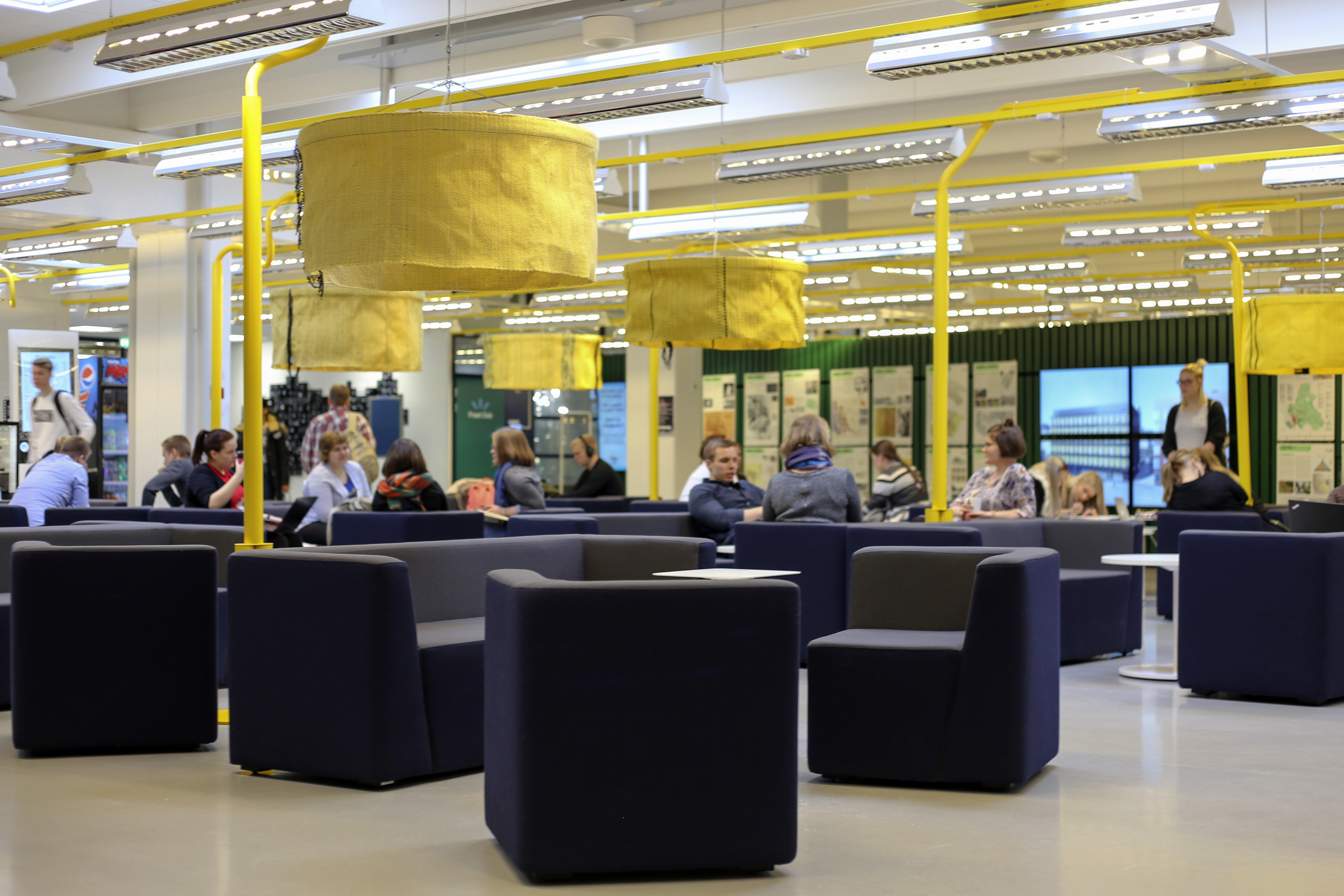
Hi, 5 Places to study other than the Pegasus Library

The Pegasus Library at the University of Oulu is one of the best places to study. It is quiet, comfortable, and you have access to everything you need. However, for many of us, the library atmosphere might actually feel overwhelming. In that case, we can try one or several of the following five alternative places.

TEKSTI Marcelo Goldmann

KUVAT Marko Heikkinen

Tellus Innovation Arena

If you don’t want to go very far from the Pegasus Library, there is the Tellus area where you can find a cozy place to study by yourself or with classmates. There are several open tables, covered areas, and even closed cabinets where you can study for your next exam. If you have a large group of classmates to study with, you can reserve one of the meeting rooms.

As an added bonus, you can rest in the Nest or even take a nap for a while to recover your energies. Moreover, you can easily get a small snack, coffee, or tea at the TellUs coffee shop. Try the espresso! And hey, the students of Kontinkangas campus: your very own Tellus Kontinkangas will be finished in the autumn of 2019!


Home

Studying at home is a double-edged sword. While you’re at home, you’re the master of your surroundings, the queen or king of your castle. You can decide how to study, where to study, what music to play, and how often to take breaks. You can prepare the snacks and drinks you like whenever you want. However, many people find working and studying at home very difficult because of all the distractions. It is somehow much easier to procrastinate at home than in a strictly study environment like a library. However, with a little discipline, you can find that sweet spot where you can comfortably study without procrastinating too much.


A classmate’s place (or your place with a classmate)

If you find it hard to study on your own, you can ask a classmate or friend to study with you, either at your place or theirs. This will allow both of you to keep each other motivated. Certainly there’s the risk that you will both feed each other’s procrastination, so make sure you are in the right mindset to study together. As an added bonus, you can ask each other questions that you don’t understand. Two heads are better than one.


Coffee shop

Some people find it easier to study when there is real life ”white noise” in the background, such as the noises found in a coffee shop. Sure, you can also get those coffee shop sounds online, but nothing beats the real thing. It’s always nice to have someone else serve you coffee and cake, even if you have to pay for it.


Outdoors

If you prefer a more naturalistic approach, you may find the peace of mind needed to crunch all those books in the outdoors. You can go to a quiet spot in the forest and enjoy the daylight and the soft swaying of the trees and the pleasant sound of the wind.  Just make sure it’s a nice warm day without wind or rain.


Bonus tip: Whether you prefer the silence of the library, the versatility of home study, the noise of a coffee shop, or the peace of nature, the important part is that you set little goals for yourself. If you set unrealistic goals, like reading two textbooks in a day, you will find yourself demotivated. Instead, try setting more down-to-earth goals.

Marcelo Goldmann

A Doctor of Chemical Engineering from the University of Oulu. "Life is like a rubber duckie, you gotta keep it afloat to see its splendor." Instagram: @marcelogman

Lue lisää:

Staying In Oulu After Graduation?

Finish school, learn a profession, find a job. Easier said than done. The traditional ways of getting employed don’t seem to work anymore, which evokes despair and scares the living daylights out of university graduates. We talked to Oulu students and learnt how they saw their future.

TEKSTI Bianca Beyer

KUVAT Anni Hyypiö

When you ask people close to their graduation what they plan to do next, the answer is straightforward: Find a job. But what kind of a job and, more importantly, how, and where? Does everybody have to start as an unpaid intern? Are all these years of grinding away at the university assignments and thesis not supposed to be a free ticket into the first best manager position?

It’s true that the unemployment rate has increased in Finland in the recent years, especially among the young people*. In the North of the country the chances of finding a job are particularly scarce, last but not least due to the less dense population up here. “Northern graduates” choose to move south even before exploring and experiencing the local labor market. It’s hard to find a student in Oulu, who does not instantly plan a move to Helsinki.

From Oulu to the big world

Johanna Tolonen has graduated from the University of Oulu this year and is currently employed by her alma mater as a research assistant. Working at the university was never part of her plan but she enjoys the experience. Even though she could stay and continue her job, she is sure to move south when the contract ends in October.

“I always wanted to move south after graduating. I have lived in Oulu my whole life, and it’s time to see something new!” she explains.

Besides, the vacancies in her field, marketing, tend to be open mostly in the Helsinki area. She does not exclude a comeback to Oulu, perhaps for a PhD, but now she feels it’s high time to explore different regions.

So, the Finns escape from Oulu to the south. What about those who come from abroad and pick Oulu as a place to study and live? Do they actually plan to stay?

Puya Purbaba has just moved to Oulu from Iran to do his Master’s in Wireless Communications Engineering. He says that his life so far is exactly how he planned it. He has chosen this university because it has a great reputation in his field, and he wants to work in the industry after finishing his studies. Most probably not in Oulu though – he is used to living in bigger cities.

While for Purbaba our beloved city seems to be just a stepping-stone, Endrit Dosti from Albania, who coincidently starts studying in the same program this year, is more open for staying. He has already adjusted his plan by adding a possibility of working at the university and, if he decides for Academia, Oulu is definitely his first choice.

Back to the roots

Oulu does get some plus points on the students’ evaluation list but quite few show their interest in settling here. Probably, for young people this place is too small to satisfy their hunger for adventures, their ambitions and to fulfill their life-long dreams. The thing is that the situation can change once they experience the world, pay their dues and grow older.

Petteri Keinänen graduated from the University of Oulu with a degree in Mechanical Engineering. He has worked in Helsinki and occasionally all over Finland for years, and is planting his trees in Oulu again by opening his own business here – Exit Oulu, an “escape room”. Those of you who watch Big Bang Theory know what this is about – solving riddles in a closed room in order to get out of there.

He could have done it in any other city but Oulu is his sweet home. Even though he has lived in Helsinki for quite a while, he never really felt like he belonged there. Nevertheless, if you ask him now whether he has planned this all along, he’ll definitely answer with a “No”. He came up with this idea just a year ago. It wasn’t part of his “plans for the future” when he graduated.

Traveling around and seeing lots of places might bring us back to the one we’d like to settle in, as in Keinänen’s case. Being flexible and open for opportunities, like in Johanna Tolonen’s case, might bring us valuable experience. After all, life doesn’t really care much about your plans. It has been well said that if you want to make God laugh, tell him your plans.

*Source: Statistics Finland, 25 August 2015.

Bianca Beyer

When I don’t sit over plans to erase all evil and meet unicorns, or dream of eating cotton candy, I believe in hard facts and science, doing my PhD in Accounting at the University of Oulu. Using writing as an information transmitter, outlet for creativity or simply for mere entertainment, I believe I am totally living the dream with all my current jobs. Blog: beapproved.wordpress.com

Lue lisää: